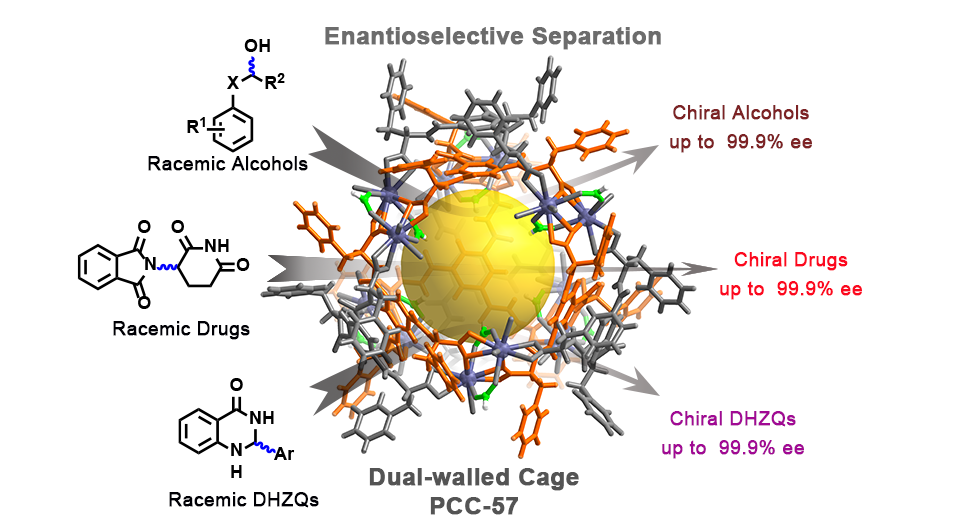
Homochiral Dodecanuclear Lanthanide “Cage in Cage” for Enantioselective Separation
- DOI码:10.1021/jacs.1c03652
- 发表刊物:Journal of the American Chemical Society
- 摘要:It is extremely difficult to anticipate the structure and the stereochemistry of a complex, particularly when the ligand is flexible and the metal node adopts diverse coordination numbers. When trivalent lanthanides (LnIII) and enantiopure amino acid ligands are utilized as building blocks, self-assembly sometimes yields rare chiral polynuclear structures. In this study, an enantiopure carboxyl-functionalized amino acid-based ligand with C3 symmetry reacts with lanthanum cations to give a homochiral porous coordination cage, (Δ/Λ)12-PCC-57.The dodecanuclear lanthanide cage has an unprecedented octahedral “cagein-cage” framework. During the self-assembly, the chirality is transferred from the enantiopure ligand and fixed by the binuclear lanthanide cluster to give 12 metal centers that have either Δ or Λ homochiral stereochemistry. The cage exhibits excellent enantioselective separation of racemic alcohols, 2,3-dihydroquinazolinones, and multiple commercially available drugs. This finding exhibits a rare example of a multinuclear lanthanide complex with a dual-walled topology and homochirality. The highly ordered self-assembly and self-sorting of flexible amino acids and lanthanides shed light on the chiral transformation between different complicated artificial systems that mimic natural enzymes.
- 论文类型:期刊论文
- 通讯作者:Zhu Chengfeng* et al.,
- 学科门类:理学
- 文献类型:J
- 卷号:143
- 期号:32
- 页面范围:12560-12566
- 是否译文:否
- 发表时间:2021-08-03
- 收录刊物:SCI
- 发布期刊链接:https://pubs.acs.org/doi/10.1021/jacs.1c03652
附件:
homochiral-dodecanuclear-lanthanide-cage-in-cage-for-enantioselective-separation.pdf
上一条:Chengfeng Zhu* et al., “Surface charges of porous coordination cage tune the catalytic reactivity of Knoevenagel condensation.”, Catal. Today, 2022, 400-401, 89-94. (第一通讯作者)
下一条:Chengfeng Zhu* et al., “Synthesis of a novel double-ligand nickel conductive metal–organic framework material and its electrochemical characterization for supercapacitors”, Mater. Sci., 2021, 56(3), 2517–2527. (第一通讯作者)