


|
个人信息Personal Information
副教授
硕士生导师
教师拼音名称:Chen Guowei
所在单位:市政工程系
学历:研究生(博士)毕业
办公地点:土木楼317
性别:女
学位:博士学位
毕业院校:中国科学技术大学
学科:市政工程
D. Gong, Y. He, X. Wen, C. Zhang, G. Chen, L. Liu, Microplastics-bacteria interfacial interactions undermine disinfection performance in drinking water systems, J. Environ. Chem. Eng. 14 (2026) 122539. https://doi.org/10.1016/j.jece.2026.122539.
点击次数:
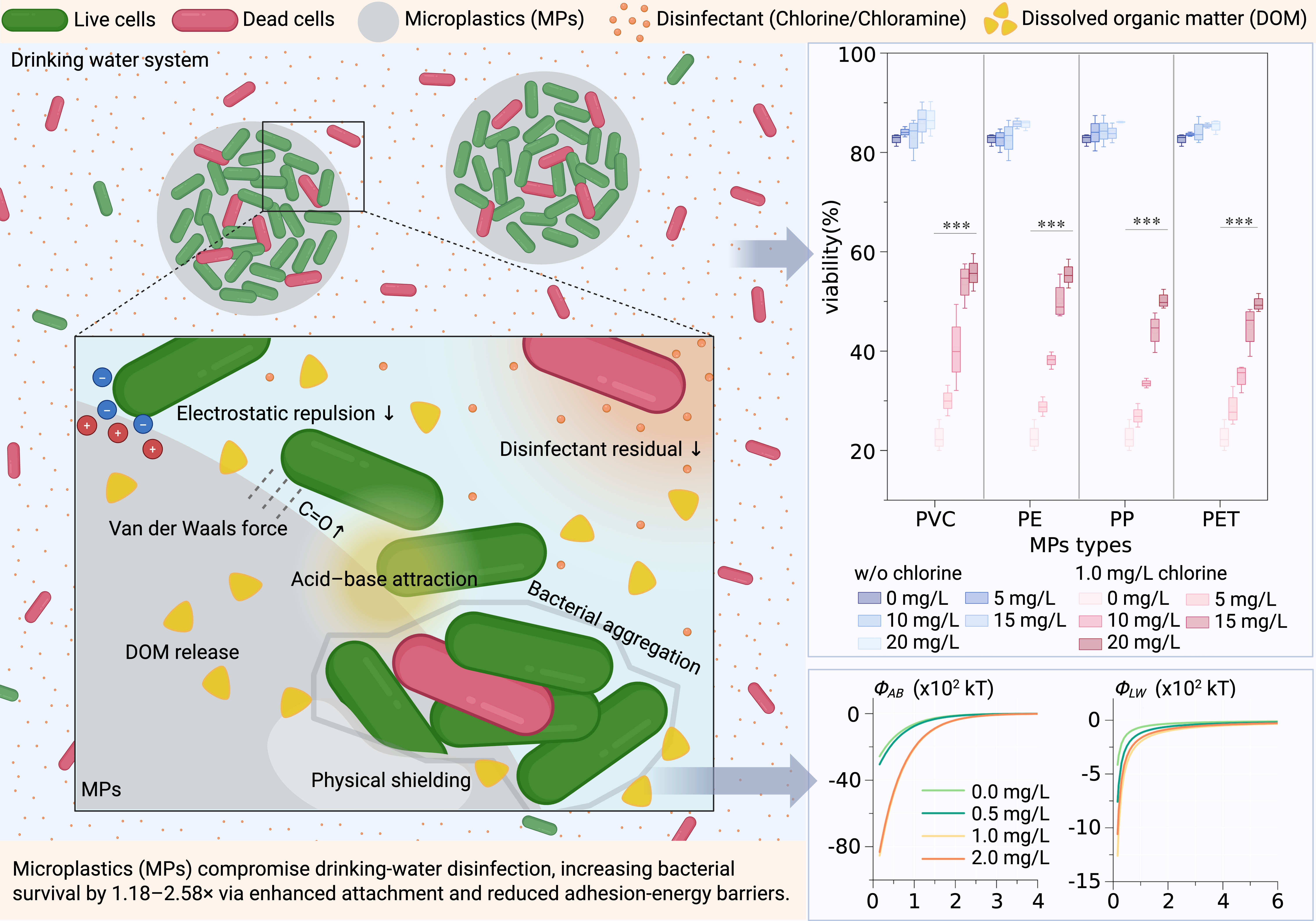
摘要:The ubiquitous occurrence of microplastics (MPs) in drinking water systems has raised escalating concerns for microbial health and water security. Although the occurrence and toxicological risks of MPs have been increasingly documented, their roles in compromising disinfection efficacy remain insufficiently understood. Here, we systematically elucidate how MPs enhance bacterial resistance to two widely used disinfectants, chlorine and chloramine, in drinking water systems. MPs increased bacterial survival by 1.18–2.58 fold, with protection intensifying at higher MP and disinfectant concentrations (0–2.0 mg/L). This phenomenon was closely associated with disinfectant-induced oxidative stress, which promoted rapid bacterial attachment on MP surfaces, increasing attachment rates from 15.88% to over 80% after 0.5 h exposure to 2.0 mg/L chlorine. Fouriertransform infrared spectroscopy and extended Derjaguin-Landau-Verwey-Overbeek modeling revealed that oxidative modification of both MP surfaces and bacterial envelopes enhanced interfacial compatibility and strengthened MP-bacteria interaction energies, reducing the adhesion energy barrier from 140.69 kT to 45.83 kT and facilitating irreversible colonization. Additionally, MPs accelerated disinfectant decay and released dissolved organic matter, generating nutrient-enriched microhabitats that supported prolonged bacterial persistence. Highthroughput sequencing further showed that MP-associated biofilms selectively enriched adhesive and disinfectant-resistant taxa, reshaping biofilm communities under disinfection stress. Collectively, these findings demonstrate that MPs compromise disinfection efficacy through synergistic mechanisms involving physical shielding, chemical scavenging, and microhabitat restructuring, highlighting the imperative to integrate MPassociated risks into microbial safety management and regulatory frameworks for drinking water systems.
是否译文:否
收录刊物:SCI
上一条:D. Guo, C. Yuan, C. Zhang, M. Zheng, G. Wang, L. Liu, G. Chen, Chlorination promotes antibiotic resistance dissemination via conjugative transfer and stress response in reclaimed water, J. Environ. Manage. 404 (2026) 129588. https://doi.org/10.1016/j.jenvman.2026.129588.
下一条:Y. Ding, K. Wang, C. Zhang, G. Wang, L. Liu, G. Chen, Floc density-driven bacterial community succession orchestrates antibiotic resistance dissemination in activated sludge, Environ. Sci. Water Res. Technol. 12 (2026) 970–981. https://doi.org/10.1039/D5EW00515A.