


|
个人信息Personal Information
副教授
硕士生导师
教师拼音名称:Chen Guowei
所在单位:市政工程系
学历:研究生(博士)毕业
办公地点:土木楼317
性别:女
学位:博士学位
毕业院校:中国科学技术大学
学科:市政工程
Y. Ding, K. Wang, C. Zhang, G. Wang, L. Liu, G. Chen, Floc density-driven bacterial community succession orchestrates antibiotic resistance dissemination in activated sludge, Environ. Sci. Water Res. Technol. 12 (2026) 970–981. https://doi.org/10.1039/D5EW00515A.
点击次数:
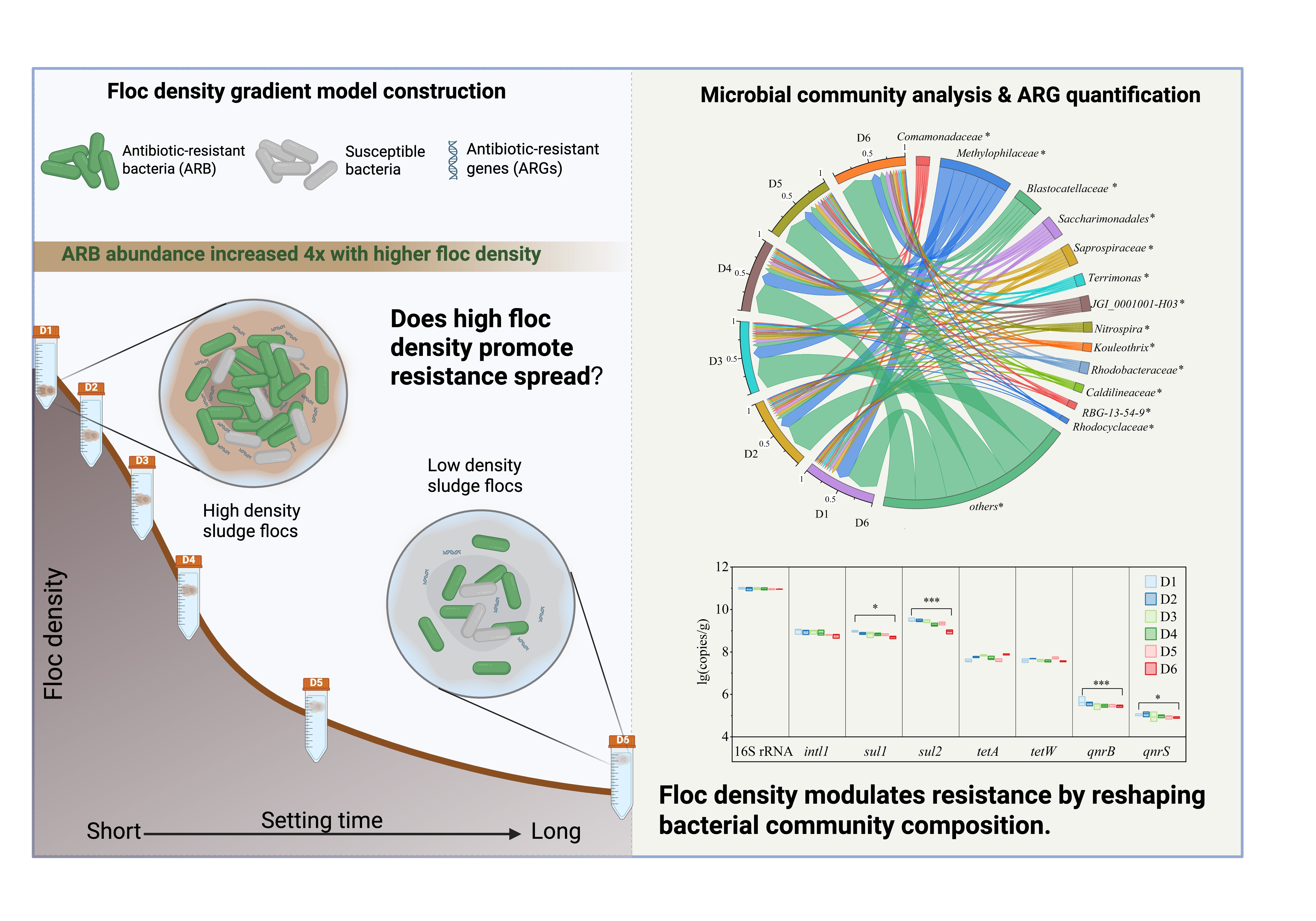
摘要:In biological wastewater treatment units, bacteria can self-assemble into flocs with heterogeneous structural characteristics. These flocs, varying in density, create dynamic microenvironments that reshape bacterial community assembly and influence the dissemination of antibiotic resistance, a process that is not yet fully understood. This study investigated the evolution of antibiotic resistance across floc density gradients to elucidate the key driving mechanisms. An increase in floc density from 1.0020 g mL−1 to 1.0029 g mL−1 triggered a fourfold rise in the absolute abundance of antibiotic-resistant bacteria (ARB) ( p < 0.05), with their relative abundance increasing from 64% to 89%. Microbial community analysis revealed significant shifts at both the phylum and genus levels across varying floc densities ( p < 0.05), likely driven by floc density-mediated changes in nutrient availability. Notably, the resource-sensitive Methylophilaceae declined in denser flocs, whereas the nutrient-tolerant Saccharimonadales and Blastocatellaceae proliferated. Furthermore, both the absolute and relative abundances of key antibiotic resistance genes (ARGs), including class 1 integron (intI1), sulfamethoxazole- (sul1 and sul2) and ciprofloxacin-related resistance genes (qnrB and qnrS), increased with increasing sludge density. Particularly, sul1 and sul2 exhibited 1.9-fold and 4.5-fold upregulations, respectively ( p < 0.05). These findings highlight strong linkages among floc density, bacterial community composition and antibiotic resistance profiles, suggesting that floc density modulates resistance by reshaping the bacterial community composition in activated sludge. This study provides insights into the ecological mechanisms governing antibiotic resistance in wastewater treatment systems, aiding improved risk assessment and management strategies.
是否译文:否
收录刊物:SCI
上一条:D. Gong, Y. He, X. Wen, C. Zhang, G. Chen, L. Liu, Microplastics-bacteria interfacial interactions undermine disinfection performance in drinking water systems, J. Environ. Chem. Eng. 14 (2026) 122539. https://doi.org/10.1016/j.jece.2026.122539.
下一条:X. Wu, H. Sun, G. Wang, L. Liu, M. Zheng, G. Chen, Sub-inhibitory antibiotics reshape resistance dynamics in cyanobacteria-dominated waters, J. Environ. Sci. (2025). https://doi.org/10.1016/j.jes.2025.08.010.