


|
个人信息Personal Information
副教授
硕士生导师
教师拼音名称:Chen Guowei
所在单位:市政工程系
学历:研究生(博士)毕业
办公地点:土木楼317
性别:女
学位:博士学位
毕业院校:中国科学技术大学
学科:市政工程
F. Wu, C. Yuan, C. Ruan, M. Zheng, L. Liu, G. Wang, G. Chen, Coagulation promotes the spread of antibiotic resistance genes in secondary effluents, Environ. Pollut. 355 (2024) 124245. https://doi.org/10.1016/j.envpol.2024.124245.
点击次数:
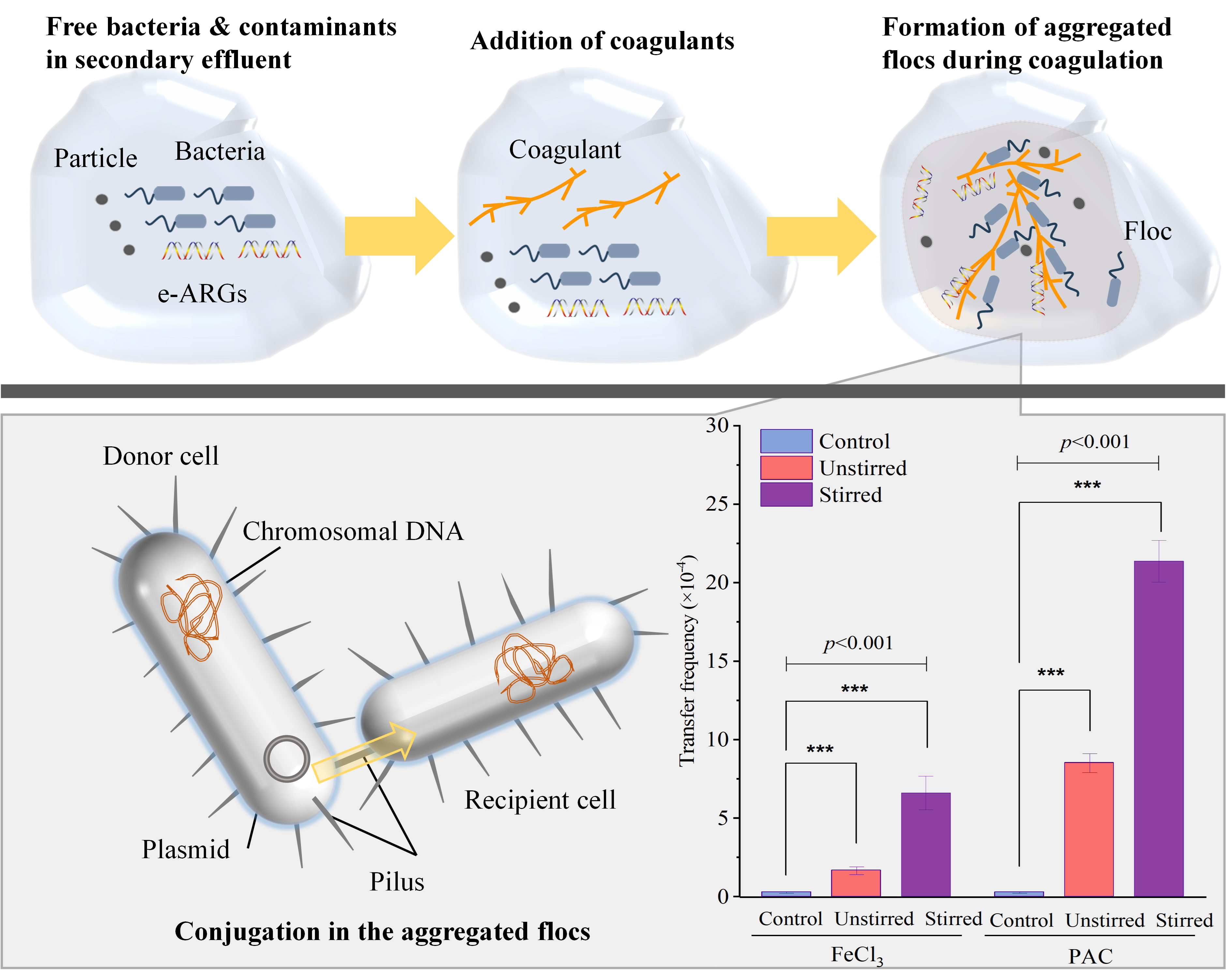
摘要:Wastewater treatment plants (WWTPs) are biological hotspots receiving the residual antibiotics and antibiotic resistant bacteria/genes (ARB/ARGs) that greatly influence the spread of antibiotic resistance in the environment. A common method used in WWTPs for the purification of secondary effluent is coagulation. Notwithstanding the increasing health concern of antibiotic resistance in WWTPs, the impact of coagulation on the emergence and spread of antibiotic resistance remains unclear. To shed light on this, our study investigated the behavior of four representative ARB types (tetracycline, sulfamethoxazole, clindamycin, and ciprofloxacin resistance) during the coagulation process in a model wastewater treatment plant. Our search showed a significant reduction in the presence of ARBs after either PAC or FeCl3 coagulation, with removal efficiencies of 95% and 90%, respectively. However, after 4 days of storage, ARB levels in the coagulated effluent increased by 6–138 times higher than the original secondary effluent. It suggests a potential resurgence and spread of antibiotic resistance after coagulation. Detailed studies suggest that coagulants, particularly PAC, may facilitate the transfer of ARGs among different bacterial species by the enhanced cell-cell contact during coagulation-induced bacterial aggregation. This transfer is further enhanced by the factors such as auxiliary mixing, longer incubation time and ideal operating temperatures. In addition, both PAC and FeCl3 affected gene expression associated with bacterial conjugation, leading to an increase in conjugation efficiency. In conclusion, while coagulation serves as a purification method, it might inadvertently boost the spread of ARGs during tertiary wastewater treatment. This underscores the importance of implementing subsequent measures to mitigate this effect. Our findings provide a deeper understanding of the challenges posed by bacterial antibiotic resistance in wastewater and pave the way for devising more effective ARB and ARG management strategies.
是否译文:否
收录刊物:SCI
上一条:X. Wu, W. Jia, Z. Fang, H. Sun, G. Wang, L. Liu, M. Zheng, G. Chen, Cyanobacteria mediate the dissemination of bacterial antibiotic resistance through conjugal transfer, Environ. Pollut. 359 (2024) 124592. https://doi.org/10.1016/j.envpol.2024.124592.
下一条:J. Wang, B. Deng, S. Jiang, Z. Deng, W. Wang, G. Chen, L. Liu, Optimizing Control of Secondary Water Supply Tanks for Demand Peak Staggering, Water Resour. Manag. (2024). https://doi.org/10.1007/s11269-024-03855-3.